Why Spring Bolts Are Essential for High-Frequency Access and Secure Closure?
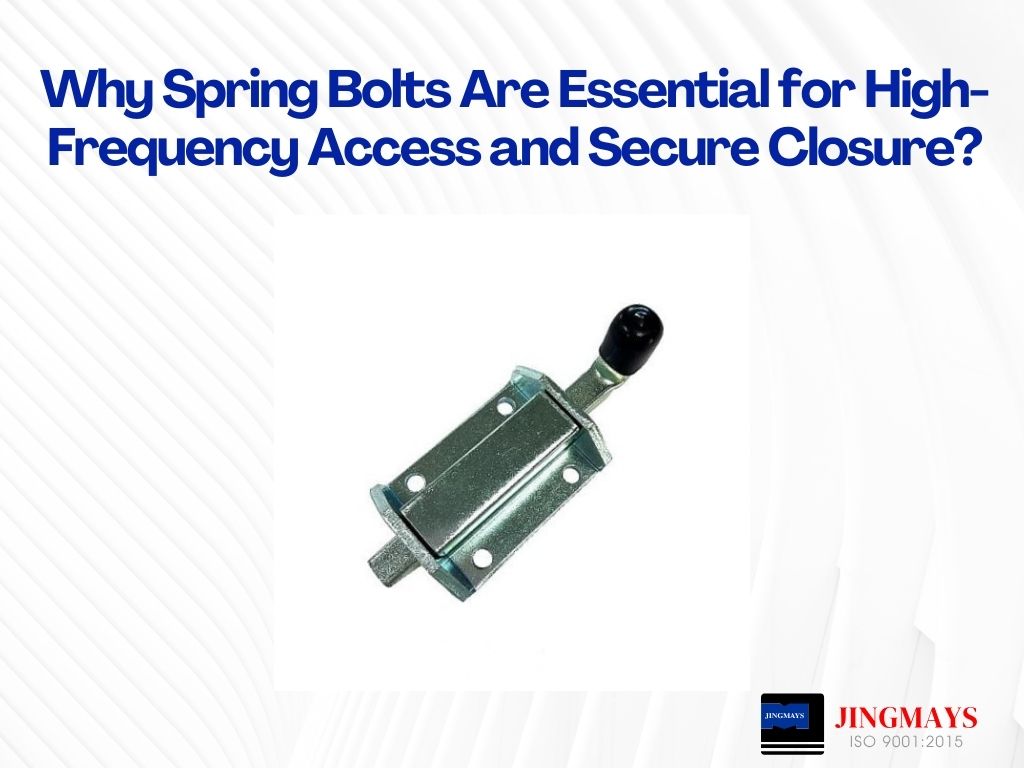
In commercial vehicles, industrial equipment, and service compartments, not all closures are designed for occasional use. Toolboxes, internal partitions, access panels, and spare tire carriers may be opened and closed dozens—or even hundreds—of times per day. In these applications, failure rarely comes from overload. Instead, it results from fatigue, misalignment, or incomplete re-engagement after repeated operation. This is where the Spring Bolt becomes a critical component. Rather than relying on manual locking every time, a spring-loaded mechanism ensures automatic engagement, consistent holding force, and fast operation even after thousands of cycles.
As a professional manufacturer of commercial vehicle and industrial hardware, Jingmays Industrial Co., Ltd. designs and manufactures industrial-grade Spring Bolts engineered specifically for high-frequency operation, vibration exposure, and long-term durability. This article explains why Spring Bolts are indispensable in repetitive-access environments and what engineering factors determine their real-world reliability.
High-Frequency Operation: The Real Challenge in Industrial Closures
In field operations, technicians and drivers rarely stop to confirm that every compartment has been manually locked. Missed or partial engagement is one of the most common causes of door failures in service vehicles and equipment housings. Spring Bolts solve this problem through self-engaging behavior. Once alignment between the bolt and receiving hole is achieved, the internal spring automatically drives the bolt into the locked position. This eliminates dependence on operator attention and ensures consistent closure after every use.
For fleet operators and equipment builders, this translates into:
- Fewer accidental open-door incidents
- Reduced maintenance calls
- Improved operational safety
Consistent Holding Force Over Thousands of Cycles
Unlike manual slide bolts that rely entirely on user force, Spring Bolts generate locking pressure through a calibrated internal spring. This delivers repeatable engagement force throughout the product’s service life. However, consistency depends on proper spring engineering:
- Correct preload to ensure positive engagement
- Controlled stroke length to avoid over-compression
- Fatigue-resistant spring materials
Jingmays optimizes these parameters to maintain reliable locking performance even under continuous cycling and vibration exposure.
Auto-Slam Engagement for Imperfect Alignment
In real working conditions, doors are not always closed gently or perfectly aligned. Service compartments may be slammed shut quickly, especially in mobile work environments. To ensure engagement under imperfect closure conditions, Jingmays Spring Bolts feature optimized bolt head geometry. A precisely designed chamfer angle allows:
- Smooth bolt retraction upon impact
- Automatic extension once alignment is reached
- Reduced impact stress on both latch and frame
This auto-slam behavior improves user convenience while minimizing long-term wear on mating surfaces.
Vibration Resistance in Mobile Environments
Commercial vehicles, agricultural machinery, and construction equipment are continuously exposed to vibration. Conventional latches may loosen or disengage over time under such conditions. Spring Bolts maintain engagement because:
- Locking force is continuously applied by internal spring pressure
- No reliance on gravity or friction alone
- Reduced risk of accidental release under vibration
This makes Spring Bolts particularly effective for:
- Service truck compartments
- Trailer access panels
- Internal equipment housings
- Utility vehicle storage boxes
Installation Precision for Long-Term Reliability
Even the best Spring Bolt design depends on correct installation. To ensure maximum service life:
- Bolt and strike alignment must be accurately maintained
- Mounting surfaces should be reinforced in vibration-prone environments
- Excessive spring preload should be avoided to prevent fatigue
Jingmays provides application guidance to OEM customers to ensure that Spring Bolts operate within their designed mechanical range throughout long-term service.
FAQ: Spring Bolts in High-Frequency Applications
Q1: Why are Spring Bolts better than manual slide bolts for service compartments?
Spring Bolts automatically re-engage, eliminating missed locking and reducing operator dependency in repetitive access environments.
Q2: Can Spring Bolts handle continuous vibration?
Yes. Internal spring-driven engagement maintains consistent locking pressure even under constant vibration.
Q3: What is the main cause of Spring Bolt failure?
Improper alignment or excessive impact loading during installation are the most common causes—not normal cycling.
Q4: Are Spring Bolts suitable for outdoor and mobile equipment?
Yes. With proper material and surface treatment selection, they perform reliably in outdoor and vehicle applications.
Conclusion
A Spring Bolt may appear simple, but in high-frequency access environments its automatic engagement, fatigue-resistant design, and vibration-stable locking make it indispensable. When properly engineered and installed, Spring Bolts reduce maintenance costs, improve operational safety, and ensure consistent closure performance over thousands of cycles.
With precision manufacturing and application-driven engineering, Jingmays Industrial Co., Ltd. delivers Spring Bolt solutions trusted by commercial vehicle builders and industrial equipment manufacturers worldwide.
✉ Contact Jingmays Industrial Co., Ltd.